
Scooter and Wheelchair Battery Guide: IATA Battery Rules for Air Travel
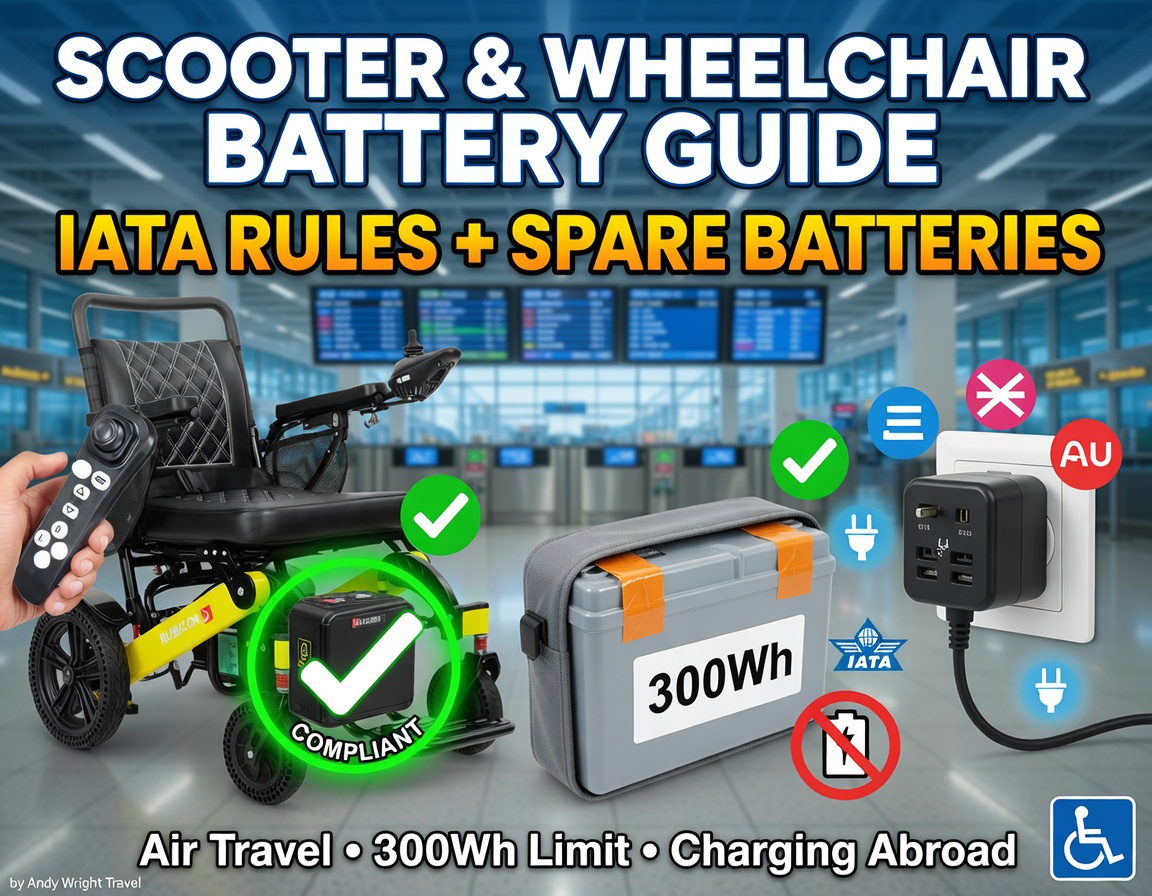
Scooter and Wheelchair Battery Guide: IATA Battery Rules for Air Travel, Spare Battery Regulations, and Charging Solutions When Travelling Internationally
Hey team, Andy Wright here from Andy Wright Travel — your go-to wheelchair traveller and accessibility vlogger. If you’ve followed my trips from the cobbled streets of Bath to the humid markets of Bangkok, you know one thing can kill a perfect journey faster than a surprise kerb: battery drama. I’ve learned this the hard way — once in Khon Kaen when an airline nearly refused my scooter because I hadn’t pre-notified them, and another time in Bangkok when I had another spare battery, taking it back to the UK.
With more of us relying on electric mobility scooters and power wheelchairs for independent travel, the rules around lithium batteries are stricter than ever. The latest IATA Dangerous Goods Regulations (67th Edition, effective January 2026) are crystal clear, and they apply to pretty much every international flight. Here’s the no-BS guide I wish I’d had years ago.
1. IATA Rules for Battery-Powered Mobility Aids on Flights
All lithium-ion (and lithium polymer) batteries in wheelchairs or scooters must have passed the UN 38.3 safety tests. Most modern devices do, but check your manual or contact the manufacturer for proof.
Installed batteries (the ones in your chair/scooter):
- They can usually stay attached if the device’s design fully protects the battery from damage and the electrical circuits are isolated (no chance of accidental activation).
- To prove isolation, put the chair in drive mode and test the joystick — it shouldn’t move.
- Terminals must be protected from short circuits (factory casing usually does this, but double-check).
If the design doesn’t provide enough protection:
- The battery must be removed following the manufacturer’s instructions.
Key watt-hour limits (this is the big one everyone gets wrong):
- Installed battery: Generally fine up to 300 Wh total.
- If it exceeds 300 Wh, some airlines may require extra safety measures or removal.
Spare / removed batteries:
- You may carry a cumulative total of 300 Wh per mobility aid.
- That means one spare up to 300 Wh OR two spares up to 160 Wh each.
- All lithium spares and removed batteries MUST travel in the cabin (your hand luggage or personal item). They are never allowed in checked baggage.
- Each battery must be in its own protective pouch or case to prevent damage and shifting. Exposed terminals must be taped or capped with non-conductive material.
Lithium metal (non-rechargeable) batteries are completely forbidden with mobility devices.
2026 update note: While general lithium batteries shipped as cargo now have stricter state-of-charge rules (often 30% max), mobility aids for passengers follow the specific IATA wheelchair guidance above. Still, it never hurts to travel with batteries at a lower charge for safety.
2. Spare Battery Regulations – What You Can (and Can’t) Bring
Spare batteries are your lifeline on long layovers or when hotels have dodgy power. But airlines treat them like mini bombs if not prepared correctly:
- Carry them on your person or in carry-on only.
- Pack each one separately in a sturdy, padded bag (or as I did, a Tesco carrier!).
- Label them clearly with watt-hours (calculate as Volts × Amp-hours).
- You must tell security and the gate agent exactly where they are.
Pro tip from the road: Never, ever put them in checked luggage — that’s an instant no-go and could get your whole chair offloaded.
3. How to Prepare Before You Fly (The Checklist That Saves Trips)
Contact your airline at least 48–72 hours in advance (some want 7 days). Send them:
- Make and model of your device
- Battery type, Wh rating, and proof of UN 38.3 compliance
- Whether the battery is removable and instructions
- How do you isolate the circuits
- Dimensions and weight when folded
Most airlines will reply with an approval reference. Print or screenshot it — I’ve had check-in staff Google the rules while I stood there smiling with the email ready.
At the airport:
- Arrive early.
- Clearly mark your chair “Battery Powered Mobility Aid”.
- Have your batteries ready for inspection.
4. Charging Solutions When Travelling Internationally
Once you land, the next headache is plugging in. Here’s what actually works:
Voltage & Plug Adapters
- Most power-chair chargers are not dual-voltage. Check your manual — if it says 110-240V, you’re golden and only need a plug adapter.
- If it’s single-voltage (e.g., 110V only), you need a step-down voltage converter/transformer rated for at least 2–3 times your charger’s wattage (they draw a lot when charging).
My travel kit (always in my carry-on):
- Universal travel adapter (covers UK, EU, US, AUS, etc.)
- High-quality surge-protected power strip (one UK, one EU, one US plug)
- Portable power station (e.g., 500–1000Wh models that are airline-approved as a “device”)
- Solar panel charger as backup for multi-day adventures
Hotel hacks:
- Ask for a room near a full-voltage outlet (not just the low-power USB ones).
- Never charge overnight unsupervised — lithium batteries can get warm.
- Some hotels have 220V hairdryer outlets in bathrooms; use with a converter.
Red flags to watch:
- Chargers that get hot or smell funny — stop immediately.
- Cheap, no-name converters that overheat.
- Countries with unstable power (parts of Southeast Asia, Africa) — always use a surge protector.
Final Thought from 180+ Flights
Battery rules aren’t there to ruin your holiday — they’re there to keep everyone safe in the air. Five minutes of prep and the right paperwork can mean the difference between an epic accessible adventure and a nightmare at the gate.
Drop your own battery horror stories or lifesaving hacks in the comments. I read every single one and feature the best in future vlogs.
Safe travels, charged wheels, and see you on the road, Andy Wright, Wheelchair traveller, vlogger, and the guy who’s been there when the battery light starts flashing.